

Some of the weirdest programming languages push the boundaries of what code can look like, and languages like Piet, Chef, Shakespeare, LOLCODE, and INTERCAL perfectly showcase this playful experimentation. Each of these unconventional languages transforms programming into an artistic, literary, or humorous experience rather than a purely technical one. Piet uses abstract art as code, Chef turns programs into quirky recipes, and Shakespeare structures its logic like dramatic plays. LOLCODE embraces meme-driven “LOLspeak,” while INTERCAL intentionally rejects normal conventions to create something bizarrely complex.
Although none of these languages are designed for practical development, they highlight the creativity and expressive potential hidden within programming. By challenging traditional rules, they encourage programmers to think differently, explore unconventional logic, and appreciate the surprising versatility of code.
Weird programming languages—also known as esoteric programming languages—are designed to challenge traditional thinking. People create weird programming languages to explore the humorous, and experimental side of programming that traditional languages rarely showcase. These unconventional designs let developers challenge assumptions about how code should look, pushing boundaries in logic, syntax, and expression. Some are built as artistic or literary experiments, others as satire of overly complex languages, and many simply as fun thought exercises that spark curiosity. By breaking norms, weird languages help programmers think more flexibly, inspiring new problem-solving approaches and highlighting that coding can be both playful and intellectually stimulating.
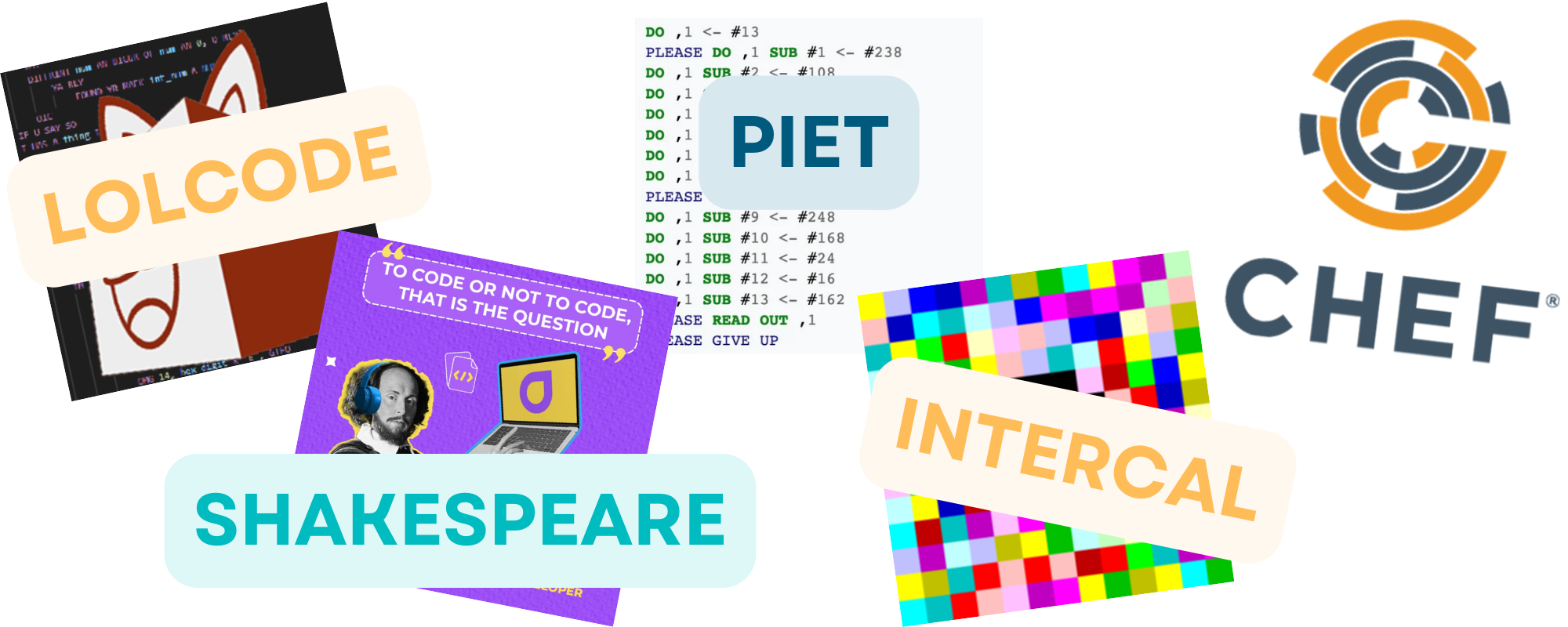
LOLCODE is considered one of the weirdest programming languages because it mimics internet “LOLspeak,” making its syntax intentionally humorous and chaotic. This meme-driven style makes the code fun but difficult to read or maintain compared to traditional languages.
Example LOLCODE:
HAI 1.2
CAN HAS STDIO?
VISIBLE “HAI WORLD!”
KTHXBYE
Through the chaos and humour of internet memes, LOLCode can be a fun way to introduce coding to your kids!
Named after Dutch artist Piet Mondrian, Piet uses abstract art as its code. Programs are drawn as colorful images, where color changes represent instructions. This allows programmers who enjoy drawing and visual creativity to “paint” their code instead of typing it. If your child enjoys using Scratch or digital art tools, Piet could be an exciting next step.
Looking to find out more about Piet? Check out this page to get started coding your own masterpieces!
INTERCAL was created as a parody of programming languages—it’s full of unnecessary rules and exaggerated politeness. For example, it uses commands like “PLEASE DO” instead of traditional ones like “print” or “run.” While this sounds confusing (and it is!), it introduces the importance of language structure in how different programming languages are designed. Given how funny and challenging INTERCAL can be to learn, it’s an excellent tool for strengthening logical reasoning through humour.
The Shakespeare Programming Language (SPL) turns programs into what look like Shakespearean plays. Variables become characters like “Romeo” and “Juliet,” and the interactions between them determine what the code does. A program might literally read like a script—something that appeals to both readers and performers. This language combines literary art and logic into an elegant artform that’s entertaining to both write and read!
Chef is a programming language that makes code look like a cooking recipe! Variables are ingredients, and instructions are written like steps in a cookbook. For example, a simple “Hello World” program might start with “Take a bowl, put sugar into it…” and end with “Serve with joy.” Another example is this ‘recipe’ to output “HI!”.
With Chef, programmers of all ages can cook up their own ‘recipes’ for a deliciously entertaining experience!
Though these languages may seem unusual, the thinking behind them supports learning standard coding languages like Python or JavaScript. By studying the weirder programming languages, programmers develop transferable skills as they:
Children who play with unusual coding languages are more likely to think like innovators. They understand that coding is about expressing an idea or solving a problem creatively—whether through colors, words, or recipes. This mindset benefits them in school, creative hobbies, and future careers.
In a world where technology evolves quickly, adaptability matters more than memorizing one “right” language. Exploring non-standard languages helps kids stay open-minded, flexible, and ready to learn whatever comes next.
By framing exploration as play, you help your child associate coding with curiosity, not pressure. Coding schools, like The Lab Singapore, are also other areas that offer opportunity to explore coding through play and fun challenges.
Coding can be as playful and imaginative as storytelling, painting, or cooking.
By introducing your child to weird and wonderful coding languages like LOLCODE, Piet, INTERCAL, Shakespeare, or Chef, you help them see the fun and creativity behind technology. These languages may look strange, but they teach vital lessons about logic, structure, and problem-solving in an engaging way.
Whether your child is just starting out or experimenting at home, letting them explore unusual programming worlds can boost their curiosity and confidence. Encourage them to think outside the box, laugh at the quirks, and discover how coding can be both weird—and wonderful.
They share the same logical foundations: variables, commands, and order of operations.
Exploring odd syntax helps kids understand how coding languages are structured. When they move to Python, Scratch, or JavaScript, they will have an easier time picking those languages up because their fundamentals are stronger.
Because it nurtures creativity, adaptability, and curiosity. Weird coding languages show kids that there’s no single “right” way to think—an essential lesson for lifelong learning and problem-solving.
Not if introduced gently and for fun! Think of them as puzzles or creative exercises, not as replacements for mainstream coding.