

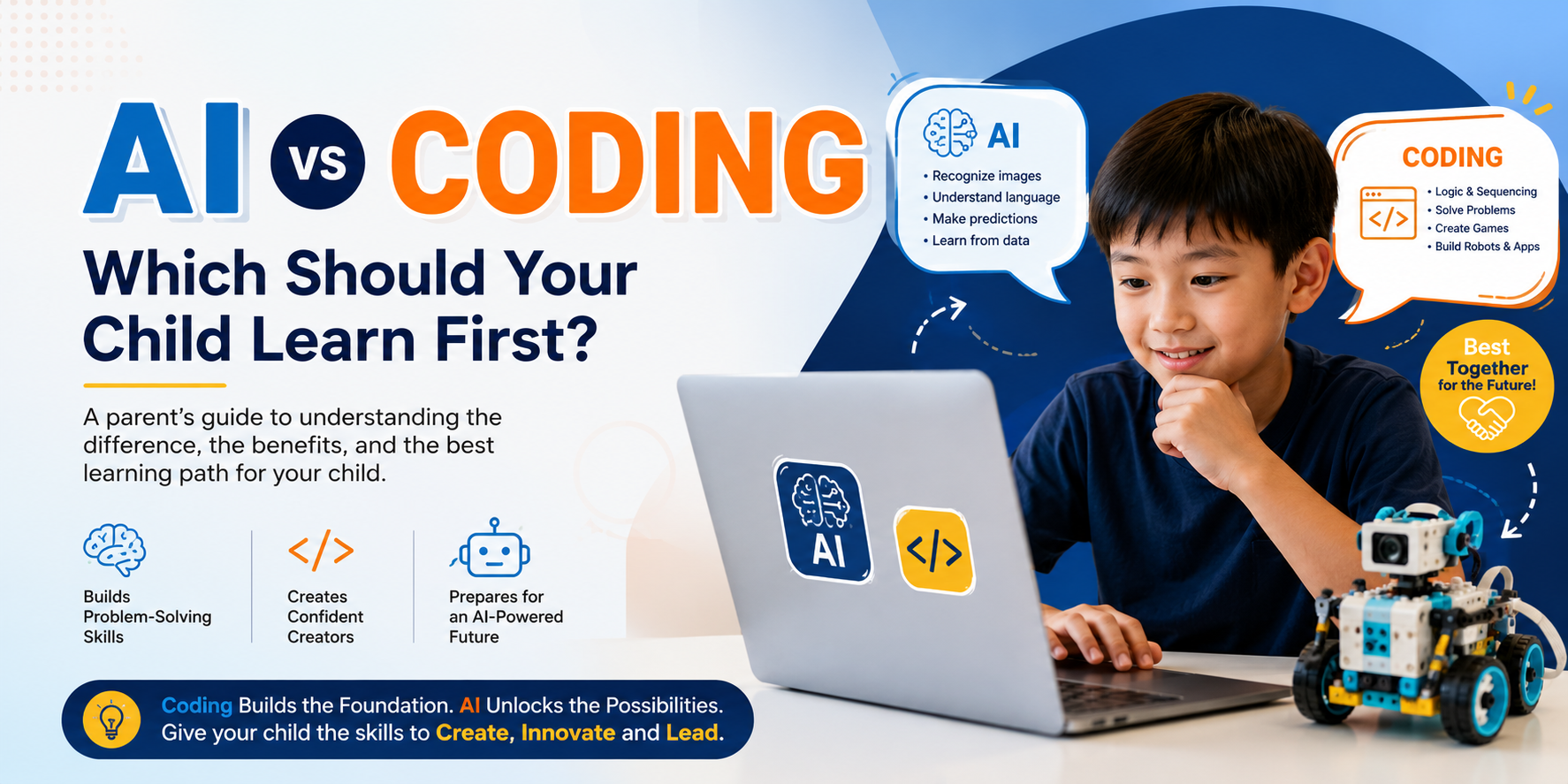
AI vs Coding for Kids: Which Should Your Child Learn First?
Should kids learn coding or AI first? With Artificial Intelligence becoming part of everyday life, many parents are asking whether their children should start learning AI instead of coding.
The good news is that you don’t necessarily have to choose one.
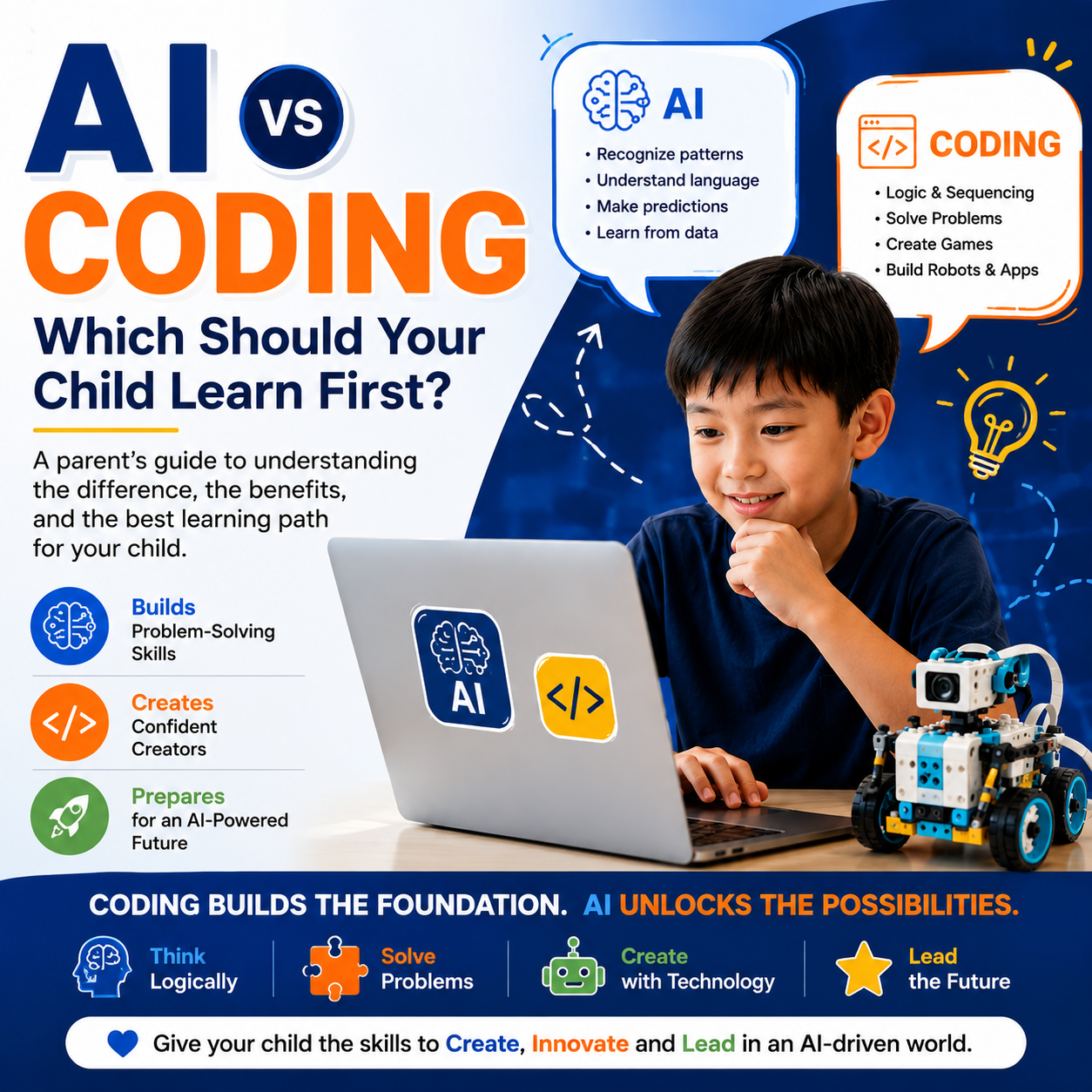
For most children, coding provides the foundation, while AI builds on that foundation. Learning both can help children develop problem-solving skills, computational thinking, creativity and the ability to use technology as a tool for creating rather than simply consuming.
If you’re wondering whether your child should learn coding or AI first, here’s what parents need to know.
AI vs Coding: What’s the Difference?
Before deciding what your child should learn, it helps to understand the difference between coding and AI.
What Is Coding for Kids?
Coding is the process of giving instructions to a computer so that it can perform a task.
For children, coding can involve creating games, programming robots, building animations or developing simple applications.
Through coding, children learn important concepts such as:
- Logical thinking
- Problem-solving
- Sequencing
- Patterns
- Loops
- Conditions
- Debugging
- Computational thinking
Coding isn’t simply about learning a programming language. It teaches children how to break a problem down and find a solution.
What Is AI for Kids?
Artificial Intelligence, or AI, allows computers to perform tasks that traditionally require human intelligence.
These can include recognising images, understanding language, identifying patterns, making predictions and generating content.
For children, learning AI can involve exploring how computers recognise patterns, using AI tools, creating AI-powered projects and understanding how AI can be used responsibly.
AI is becoming an increasingly important skill for the next generation.
But there is an important distinction:
Using AI is not the same as understanding technology.
Should Kids Learn Coding or AI First?
If your child is completely new to technology, we generally recommend starting with coding and gradually introducing AI.
Why?
Because coding teaches children how technology works at a fundamental level.
Once children understand programming concepts, they have a much easier time understanding how AI-powered tools work and how they can use AI to create their own projects.
Think of it this way:
Coding = Foundation
AI = Powerful Tool
Coding + AI = Creation
Learning coding first doesn’t mean your child needs to spend years learning programming before touching AI.
Instead, children can be introduced to AI alongside age-appropriate coding and robotics activities.
5 Reasons Kids Should Learn Coding Before AI
1. Coding Develops Problem-Solving Skills
One of the biggest benefits of coding for children is that it teaches them how to solve problems.
A program doesn’t work.
A robot doesn’t move.
A game doesn’t behave as expected.
Instead of simply giving up, children learn to investigate what went wrong, test different solutions and try again.
This process develops problem-solving and critical-thinking skills that children can use in school and everyday life.
2. Coding Builds Computational Thinking
Computational thinking is the ability to break complicated problems into smaller, manageable steps.
This is an important skill in both coding and AI.
When children learn to code, they naturally begin asking questions such as:
What is the problem?
What information do I have?
What steps do I need to take?
What happens if I change something?
These habits of thinking can become extremely valuable as children begin working with AI.
3. Coding Helps Children Understand AI
AI can sometimes feel like magic.
You type a question and an answer appears.
You upload an image and AI identifies what’s inside.
You give a prompt and AI creates an image or piece of text.
But behind these experiences are algorithms, data, patterns and instructions.
Children who understand basic coding and computational thinking can begin to understand what is happening behind the technology.
They are less likely to see AI as simply a “magic box” and more likely to understand it as a tool they can learn to use and create with.
4. Coding Encourages Children to Become Creators
Children today are surrounded by technology.
They use smartphones, tablets, games, apps and AI tools every day.
But there is a difference between using technology and creating technology.
Coding gives children the opportunity to become creators.
They can:
- Build their own games
- Program robots
- Create animations
- Develop simple apps
- Build interactive projects
- Experiment with their own ideas
This creator mindset is one of the most important benefits of learning coding for kids.
5. Coding Makes Children Better AI Users
AI can generate code in seconds.
But what happens when the code is incorrect?
A child who understands programming can look at the output, identify potential problems and communicate more effectively with AI.
Instead of simply asking:
“AI, fix this.”
They can ask:
“The robot isn’t responding after the condition is triggered. Can you help me identify which part of the logic might be causing the problem?”
The better a child understands the fundamentals, the more effectively they can use AI.
Does That Mean Kids Shouldn’t Learn AI?
Not at all.
Children should absolutely be introduced to AI.
The key is to introduce AI in a way that is appropriate for their age.
For younger children, AI education can focus on concepts such as:
- How computers recognise patterns
- How AI can identify images and objects
- How machines can learn from information
- How to give clear instructions
- How to evaluate AI-generated information
- Responsible and ethical use of AI
Older students can gradually explore more advanced areas such as machine learning, computer vision, AI applications and AI-assisted coding.
Coding and AI for Kids: What Should Different Ages Learn?
Ages 5–6: Explore Through Play
Young children can begin developing computational thinking through robotics, games and simple visual programming.
The focus should be on:
- Sequences
- Instructions
- Patterns
- Cause and effect
- Problem-solving
- Creativity
At this age, learning should be hands-on and fun.
Ages 7–9: Build With Coding and Robotics
Children can begin exploring more structured programming concepts through block-based coding and robotics.
They can learn about:
- Loops
- Conditions
- Variables
- Problem-solving
- Robotics
- Basic AI concepts
Projects allow children to immediately see the results of their code, making abstract concepts much easier to understand.
Ages 10–14: Move Towards Advanced Coding and AI
Older children can gradually move into text-based programming such as Python.
This creates opportunities to explore:
- Python programming
- AI-powered applications
- Data
- Machine learning concepts
- Chatbots
- Computer vision
- AI-assisted coding
- More complex robotics projects
At this stage, coding and AI can be taught together to help students build increasingly sophisticated projects.
Will AI Make Coding Obsolete?
This is one of the biggest questions parents have.
AI can already generate code, explain programming concepts and help developers find bugs.
But this doesn’t mean that coding is becoming irrelevant.
In fact, understanding coding may become even more important.
Think about calculators.
Calculators made arithmetic faster, but they didn’t make mathematical understanding irrelevant.
Similarly, AI can make programming faster, but children still need to understand logic, problem-solving and how software works.
The skill is shifting from simply writing every line of code manually to understanding what you want to build, communicating it effectively and evaluating what AI produces.
The Future Is Coding + AI
The question shouldn’t really be:
“Should my child learn coding or AI?”
A better question is:
“How can my child learn coding and AI together?”
Coding gives children the foundation to understand technology.
AI gives them new ways to use that technology.
Together, they can help children become more confident problem-solvers and creators.
The future will not simply belong to children who know how to code.
It will belong to children who can think critically, solve problems, work with AI and turn their ideas into reality.
At The Lab, We Teach Coding, Robotics and AI for Kids
At The Lab, our technology programmes are designed to help children learn through hands-on projects rather than simply watching tutorials or memorising code.
Our programmes introduce children to coding, robotics and AI progressively according to their age and ability.
Younger children can begin with robotics and visual programming, while older students can progress into more advanced coding and AI projects.
Our goal is simple:
Don’t just teach children how to use technology. Teach them how to create with it.
Whether your child is completely new to coding or already interested in AI, learning the fundamentals can give them the confidence to explore what’s possible.
Coding gives them the foundation. AI gives them new possibilities.
And together, they give children the tools to build the future.
Frequently Asked Questions About AI and Coding for Kids
Should my child learn coding or AI first?
For most beginners, coding is a good starting point because it develops logical thinking, problem-solving and computational thinking. AI can then be introduced alongside coding as children become more comfortable with technology.
What age should children start learning coding?
Children can begin learning basic coding and computational thinking from around 5 years old through age-appropriate games, robotics and visual programming.
Is AI suitable for young children?
Yes. AI concepts can be introduced to younger children through simple, hands-on activities involving patterns, images, robotics and problem-solving. The depth and complexity should be adjusted according to the child’s age.
Will AI replace coding?
AI is changing how coding is done, but understanding programming and computational thinking remains valuable. Children who understand coding can use AI more effectively because they can evaluate, modify and troubleshoot AI-generated code.
Is coding still important in the age of AI?
Yes. Coding develops problem-solving, logic and computational thinking. These skills can help children become better users and creators of AI technology.
What is the best coding language for kids?
For younger children, block-based programming can be a good introduction. Older children can eventually progress to text-based languages such as Python, depending on their age, experience and learning goals.
Should my child learn robotics, coding or AI?
They don’t have to choose just one. Robotics can make coding highly interactive and engaging, while AI can introduce children to one of the most important areas of modern technology. A combination of robotics + coding + AI can provide a well-rounded technology education.
Ready for Your Child to Start Learning Coding and AI?
Whether your child is 5 or 14, the best time to start developing technology and problem-solving skills is when they are curious and ready to explore.
At The Lab, we help children progress from coding and robotics fundamentals to more advanced programming and AI projects, giving them the skills and confidence to become creators in a technology-driven world.
Book a trial class with The Lab and let your child discover what they can create.