

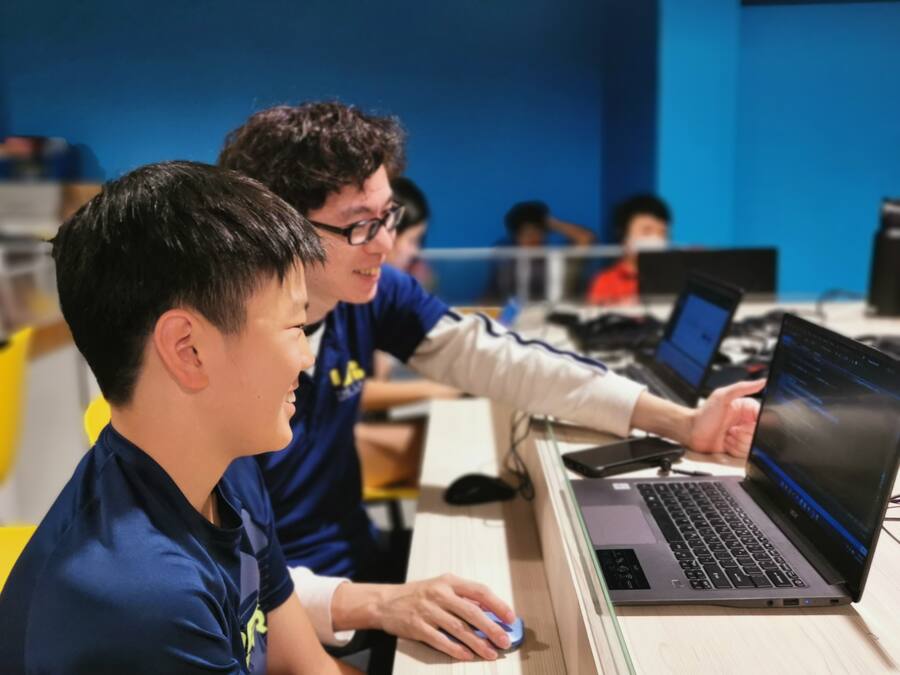
Coding Classes for Kids in Singapore
From first lines of code to real apps and games — structured, project-based coding classes for children aged 5 to 14+, taught by instructors who make programming genuinely exciting.
A Coding Path for Every Age
Every program below is built around real, hands-on coding — the difficulty and tools just grow with your child. Pick the stage that fits their age to see the full curriculum.
Kinder
Your child's first steps into code, taught through play instead of screens. Sequencing, patterns and step-by-step "if this, then that" thinking build the computational logic every coding language is built on.
Explore KinderJunior
Kids start writing real block-based code, sequencing commands and debugging their own LEGO robots when a program doesn't run as planned — the first taste of thinking like a programmer.
Explore JuniorCoder
A move into text-based coding with Python — variables, loops and functions used to build real projects in an open-lab format, with a portfolio of finished builds by the end of each term.
Explore CoderThe Lab X
Advanced, competition-level coding — algorithmic problem-solving and Unity game development on top of Python, built for teens heading into Canadian Computing and international programming contests.
Explore The Lab XWhat Do Kids Learn in Coding?
Coding at The Lab is never just about the keyword — it's a bundle of transferable thinking skills that build on each other.
Breaking complex problems into smaller, manageable steps.
Understanding sequencing, conditions, loops and functions.
Learning how to identify problems, test solutions and debug mistakes.
Understanding how a set of instructions can be designed to solve a particular problem.
Using code to turn ideas into games, apps, interactive projects and other creations.
From First Steps to Real Programming
At The Lab, coding is not taught as a one-size-fits-all subject. Children progress through increasingly sophisticated programming concepts as their ability develops.
Why Learn Python?
Python is the language our Coder students move into once they've outgrown block-based coding — and it's the strongest coding-specific differentiator The Lab has.
- Python is a real text-based programming language.
- It is widely used beyond education.
- It provides a natural progression from block-based coding.
- It opens pathways into AI, automation, data and advanced programming.
- Children learn actual programming concepts rather than simply manipulating visual blocks.
Coding Is the Foundation for Robotics and AI
Coding at The Lab doesn't stand alone — it's the base layer underneath both of our other pillars, and the Coder programme already combines all three.
Children learn how to give computers precise instructions.
They apply those instructions to physical machines.
They learn how technology can interpret information and make decisions.
What Can Kids Build With Coding?
The real answer to "what does my child actually get out of coding?"
Interactive games that allow children to apply programming logic.
Projects that combine programming concepts into useful or entertaining applications.
Projects involving user input, logic and interaction.
Code that controls physical robots and responds to sensors.
Projects that combine programming with AI concepts.
Is Coding Still Important in the Age of AI?
AI can generate code, but understanding how code works remains important. Coding develops computational thinking, logical reasoning, problem-solving and the ability to understand how technology works.
Read: AI vs Coding for Kids →Coding Competitions & Achievements
Lab students don't just learn to code — they compete with it, on national and international stages.
Why Choose The Lab for Coding?
Children move from foundational computational thinking to advanced programming.
Students use coding concepts to create things rather than simply complete worksheets.
Older students progress into real text-based programming.
Coding is applied across physical robotics and intelligent technology.
Students can challenge themselves through coding and technology competitions.
The difficulty and tools evolve with the child's development.
Coding Classes for Kids — FAQ
What age can children start learning coding?⌄
From age 5, in our Kinder programme — taught through play and sequencing rather than screens.
Does my child need previous coding experience?⌄
No. Each stage starts from where a child actually is, from complete beginners in Kinder to advanced programmers in Lab X.
What programming language will my child learn?⌄
Children start with block-based coding in Junior, then move into Python from Coder onward.
When will my child start learning Python?⌄
Python begins in the Coder programme, typically around ages 10–14.
Is Python too difficult for children?⌄
No — by the time students reach Coder, they've already built the block-based programming foundation Python builds on.
What can children build with coding?⌄
Games, apps, interactive projects, robotics code and AI projects — see "What Can Kids Build With Coding?" above.
Is coding still useful now that AI can write code?⌄
Yes — AI can generate code, but understanding how code works remains essential. See "Is Coding Still Important in the Age of AI?" above.
Does coding involve mathematics?⌄
Yes — computational thinking and programming logic draw directly on sequencing, patterns and logical reasoning.
Can coding help with problem-solving skills?⌄
Yes — identifying problems, testing solutions and debugging mistakes is core to how coding is taught at every stage.
Can my child participate in coding competitions?⌄
Yes — students can compete at events such as Coding Olympics, HCIC and NCRC through the Coder and Lab X programmes.