

If your child is between 5 and 6 years old and you’ve heard other parents talking about the National Robotics Competition (NRC) preschool category, you might be wondering whether robotics is really something a preschooler can take on — and if so, what it actually involves. The short answer: yes, and it’s one of the most accessible ways for young children in Singapore to get a genuine first taste of robotics, coding, and teamwork.
This guide walks through what the NRC preschool category is, what it takes for a young child to join, and what the 2026 competition was all about.
What Is the National Robotics Competition?
The National Robotics Competition is Singapore’s longest-running robotics event for students, organised by Science Centre Singapore since 1999 with support from the Ministry of Education. What began as the National Junior Robotics Competition has grown into a nationwide robotics programme spanning preschool, primary, secondary, and tertiary levels, engaging tens of thousands of young participants over the years.
Robotics categories in the NRC range from LEGO-based mission challenges for older students to open-ended, project-based robotics for secondary and tertiary teams. But it’s the Preschool Category, introduced to bring robotics education down to the kindergarten level, that gives the youngest learners their first structured introduction to robotics.
What Is the Preschool Category?
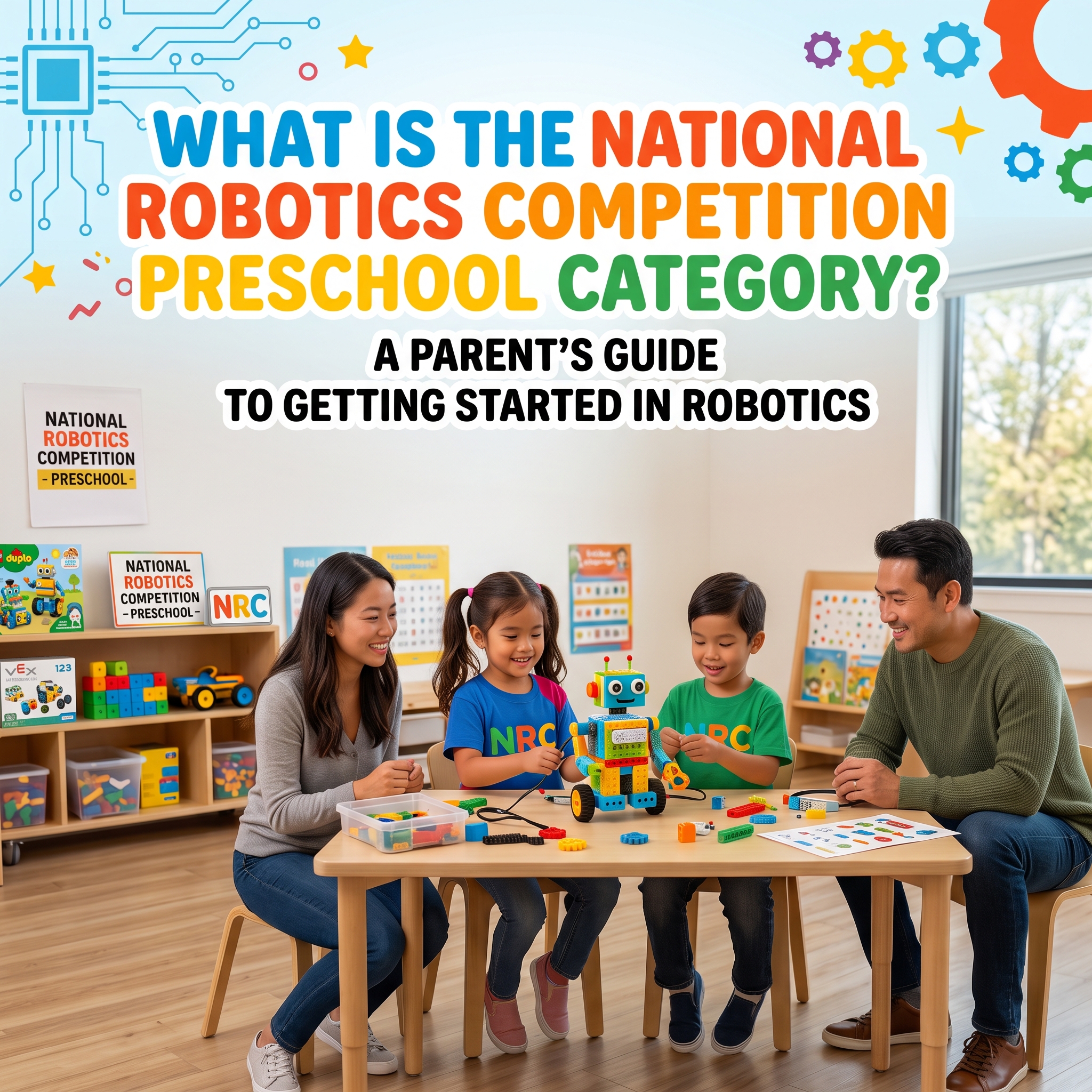
The NRC Preschool Category — sometimes referred to as the KUBO Challenge — is a robotics competition designed specifically for children aged 5 to 6. Instead of the more complex robots used in older categories, preschoolers work with KUBO, a screen-free coding robot controlled entirely with physical TagTiles. Children arrange these tiles into a sequence, and KUBO “reads” the tiles and follows the instructions across a game field — no typing, no screens, just hands-on robotics and logical thinking.
The category blends two elements that make it a genuine robotics competition rather than a simple play activity:
A robot run. Teams programme KUBO to complete a series of missions on a large game field, each themed around a real-world scenario. Children must sequence their TagTiles correctly, adapt when a mission changes, and work as a team under a strict time limit.
A presentation. Teams also design and build a costume or “carrier” for their KUBO robot using recycled materials, then present their robot and explain what they learned to a panel of judges — building early public-speaking and reflection skills alongside the robotics itself.
Together, these elements are designed to develop problem-solving, creativity, teamwork, and communication — all through the lens of robotics.
What Does It Take to Join?
Robotics competitions can sound intimidating for a preschooler, but the entry requirements are refreshingly age-appropriate.
Age and team size. Children must be 5 to 6 years old (as of 31 December of the competition year). Teams have a minimum of 2 and up to 5 members, guided by up to 2 coaches or teachers.
Equipment. Each team needs its own KUBO Coding Starter Set and KUBO Coding+ Set, plus the official KUBO TagTiles. No prior robotics experience is required — the format is built for absolute beginners.
Coaching rules. This is where the NRC preschool category really stands out: coaches may only talk, never touch. During a mission run, adults can offer verbal guidance, but every piece of coding, building, and problem-solving on the field must be done by the children themselves. Physical interference by a coach can cost a team points or even lead to disqualification. It’s a small rule with a big purpose — the robotics learning has to belong to the child, not the adult.
Presentation skills. Because part of the score comes from a presentation and Q&A session, children also need some comfort speaking in front of judges — a skill teams typically build up over weeks of practice, not something expected on day one.
Registration. Schools and enrichment centres typically register teams months ahead of the event, with registration usually closing around March for a competition held later in the year. Preparation courses — often running for several months at one to two hours a week — help children build familiarity with KUBO and robotics logic well before competition day.
In short: what it takes to join isn’t advanced robotics knowledge. It’s curiosity, a willingness to work in a team, and a KUBO robot to practise with.
What Was the 2026 National Robotics Competition About?
Every year, the NRC preschool category is built around a real-world theme that gives the robotics missions meaning beyond the game field. The theme for the 2026 National Robotics Competition Preschool (KUBO) Category was “Mission Meals.”
The story behind the theme: not every child has enough healthy food to eat, and young “Mission Meals Heroes” were tasked with using their KUBO robot to help fix that — growing crops, delivering food safely, and keeping food fresh so nothing goes to waste.
That story translated into five robotics missions, each requiring KUBO to complete a specific real-world-inspired task:
- M01 – Seed Delivery Sprint: Programme KUBO to collect and deliver seed boxes to a new farming field while avoiding obstacles.
- M02 – Water Works Rescue: Guide KUBO to collect filled water tanks and repair a broken irrigation trench.
- M03 – High-Rise Harvest: Transport and install a vertical farming unit on a rooftop garden.
- M04 – Super Safe Storage: Move fresh harvest and cold-stored produce safely into storage and distribution, including a “traffic” pause at a pedestrian crossing.
- M05 – The Healthy Plate Party: A surprise, collaborative final mission — revealed only on competition day — where KUBO helps assemble a complete healthy meal.
Robotics missions were run on a 1m x 1m game field with 400 playable grids, and teams had a fixed calibration period before each mission to prepare their coding. Scoring combined a robot run score (up to 70 points, based on accuracy and use of specific coding techniques) with a presentation score (up to 30 points, covering costume design, creativity, clarity, and reflection). An additional “Best KUBO Robot Design” award recognised the most creative and original robot builds.
Presentations and judging for the 2026 season were held at Edison Lab, Science Centre Singapore, with top teams going on to represent Singapore at the Global Robotics Games International Finals, also held in Singapore later in the year.
Why the Preschool Robotics Category Matters
It’s easy to underestimate what a 5- or 6-year-old can do in robotics, but the NRC preschool category proves the opposite. By removing screens and typing from the equation and replacing them with tactile TagTiles, KUBO makes robotics and coding concepts — sequencing, logic, cause and effect — genuinely accessible to young children. Add in a real-world theme like “Mission Meals,” a hands-on robot build, and a presentation in front of judges, and what looks like a simple robot challenge becomes a full introduction to robotics thinking, teamwork, and confident communication.
For parents wondering whether robotics is “too advanced” for a preschooler, the National Robotics Competition Preschool Category is proof that the earliest years are exactly the right place to start.